Copilot Reads Your SKILL.md Now
GitHub Copilot code review can now invoke your team's SKILL.md files and pull context from MCP servers. The skill economy is no longer theoretical.
I’ve spent the past few months writing SKILL.md files. draft-post, process-imports, code-review — each one a structured instruction set that tells a Claude Code agent how to perform a specific task in a specific project context. The idea is that the agent can find and execute it on demand, and the skill evolves alongside the project.
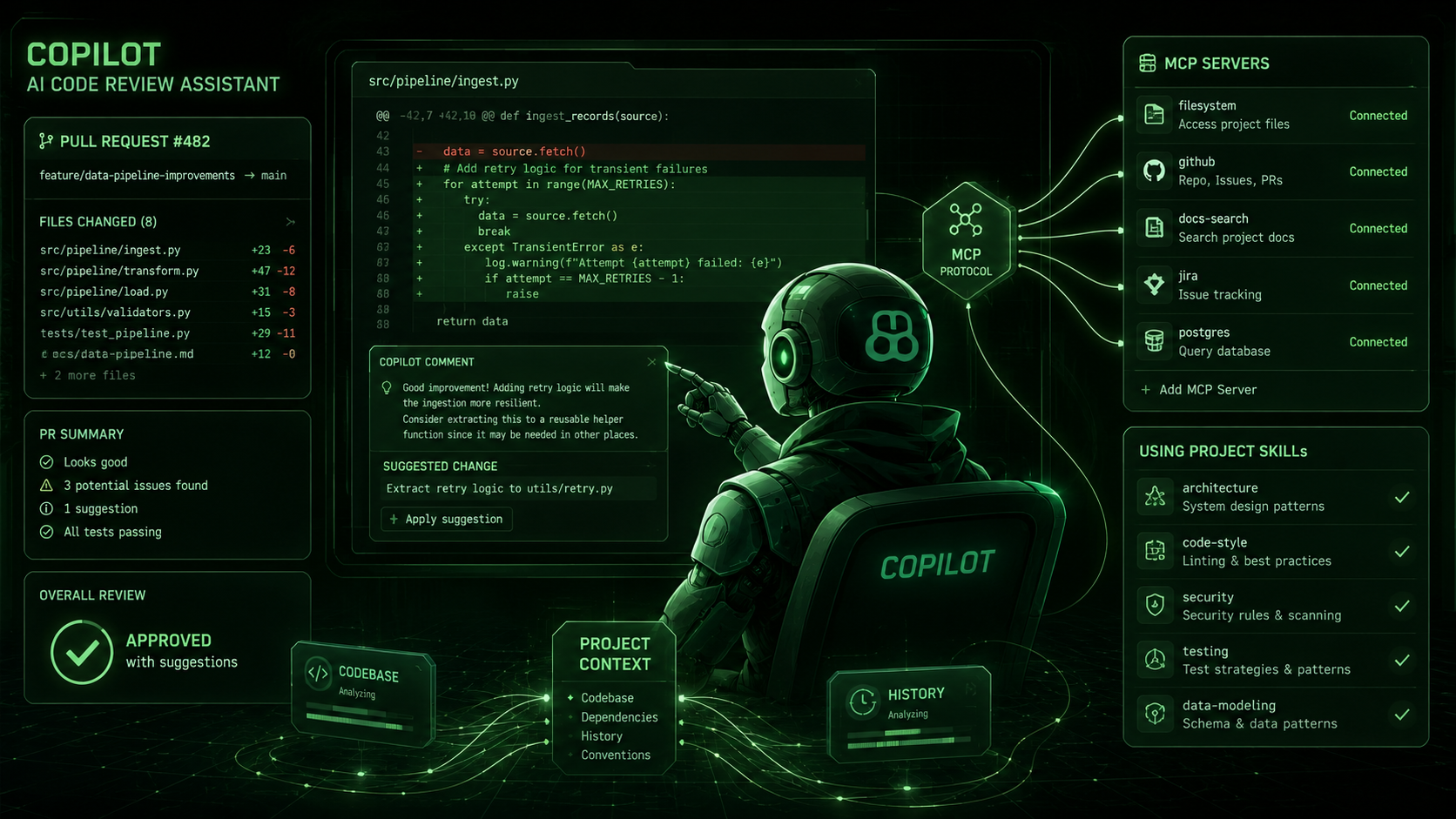
This week, GitHub made Copilot code review generally available with agent skills and MCP support. Your team’s SKILL.md files, read by Copilot during code review, across all paid tiers, in production today.
So why’s that significant?
What changed
Copilot’s code review agent was already doing AI-assisted PR review. This new capability lets it go further: it can now read your project’s SKILL.md skills to understand project-specific review criteria, AND it can pull context from MCP servers (read-only) to inform its analysis.
A SKILL.md for code review might encode your team’s security-first policy for input validation, your stance on test coverage, your component conventions, your accessibility requirements. Copilot can now read all of that and apply it during review — not just pattern-match against general best practices.
The MCP side is equally significant. A reviewer that can query your documentation server, check your internal design system, or verify a component against your established schema has real context. It’s not inferring from the diff alone; it’s reading the same authoritative sources your team uses.
Skills are the interface between AI and institutional knowledge
Here’s what building SKILL.md files has taught me: the value isn’t in the specific instructions. It’s in being forced to articulate what you actually want.
When I wrote the draft-post skill for this site, I had to specify the exact frontmatter schema, the three category names and when to use each, the tone, the word count target, the file naming convention, where the output goes. Most of that I knew intuitively but had never written down. Now it’s written down, the agent can follow it, and I can update it when conventions change.
Skills work because they encode institutional knowledge in a form AI can execute against. The alternative — restating your conventions in every session, every PR comment, every onboarding document — is a losing game at any team size.
The GitHub announcement signals that this approach is becoming standard infrastructure. Skills and MCP aren’t Claude Code-specific patterns anymore. They’re becoming the interface layer between AI coding tools and the knowledge that makes projects coherent.
What this means for my workflow
I run Claude Code, not Copilot, as my primary agent. But, the underlying pattern is identical: structured skills + MCP context = an agent that knows what “done” means for this specific project.
What I find interesting about the Copilot GA is the implicit signal about review workflow. Right now, my agent harness generates code and I review it. Once AI-assisted review is applied to AI-generated code at the same skill level, the human review step shifts from “does this code work” to “does this decision align with where we’re going.”
For a one-person project like this site, the loop is tight already. For a team producing AI-generated code at scale, review is the bottleneck — and skills-aware review that can actually evaluate against project-specific criteria without manual context-setting is a real leverage point.
The skill economy is forming
The Copilot GA, Grok 4.5 landing in Copilot this same week, the MCP stateless spec shipping — these aren’t disconnected releases. The pattern is: the agent toolchain is converging on shared protocols and shared skill formats. The SKILL.md, AgentSkills.io, MCP, A2A, structured output schemas — the conventions that felt like Claude Code-specific patterns six months ago are becoming the common vocabulary for any AI agent operating in a software development context.
That’s worth paying attention to. The teams that invest now in writing down what they actually want — in the form of skills, schemas, and structured backlogs — will have a real operational advantage when these tools hit mainstream workflow adoption.
I’m already there. The skills I’m writing this week are the ones that will be running my agent workflows for the next year. Well, until I see the next improvement coming. What I’m writing today is already superceding what I wrote 3 months ago.